
Courses

Take your Italian further by expanding vocabulary, grammar, and cultural knowledge.
Level required: A1 Beginner 5 or equivalent
Textbook: Il Nuovo Affresco Italiano – A2
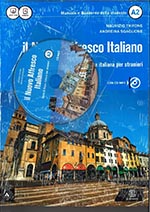
Click on the above link to purchase the textbook.
Syllabuses
A2 Elementare 1
Grammar
Definite and indefinite articles
Singular and plural of nouns, including nouns ending in -co, -ca, -go, -ga, -cia, -gia, and – a
Masculine and feminine nouns
Present tense of verbs essere and avere
Present tense of regular verbs of all three conjugations: -ARE, -ERE, -IRE
Present tense of verbs capire, finire, preferire, pulire, spedire
Invariable nouns
Noun-adjective agreement
Simple prepositions followed by a noun or a verb
Communication Skills
Reviewing personal introductions
Describing the features of people, places, and things
Discussing habits and preferences
Talking about professions, working life, and job search
Pronunciation
A2 Elementare 2
Grammar
Present tense of reflexive and reciprocal verbs
Possessive adjectives
Possessive adjectives with family nouns
Demonstrative adjectives and pronouns questo and quello
Articulated prepositions: del, della, dello, dei, degli, delle, etc.
Mi piace/ Mi piacciono
Direct object pronouns
Past tense (passato prossimo) with avere and essere
Verbs with irregular past participles
Communication Skills
Describing daily routines
Discussing family relationships
Talking about the characteristics and quality of Italian products
Expressing likes and preferences
Narrating past events and experiences
Talking about different environments, climates and cardinal directions
Booking hotels, transportation, holiday attractions and activities
Describing Italian regions
Pronunciation
A2 Elementare 3
Grammar
The adjective bello
Direct object pronouns with the past (passato prossimo)
Past particle agreement with the direct pronouns
Past tense (passato prossimo) of reflexive verbs
Present and past tense of modal verbs dovere, volere, potere
The adverb of place ci with the verb volere and other special uses
Indirect object pronouns and their usage with the verbs bastare, interessare, mancare, etc.
Present and past tense of the verb piacere
Present continuous tense
The verbs pensarci and metterci
Communication Skills
Talking about cities and their squares, streets, and monuments
Giving and understanding directions
Describing the different parts of a house
Enquiring about houses
Sharing one’s routine
Expressing likes and preferences
Discussing leisure activities
Talking about cinema, music, theatre, and sports
Accepting or refusing an invite
Pronunciation
A2 Elementare 4
Grammar
Practising the verbs piacere, bastare, mancare
Imperfect tense (imperfetto indicativo) of all three conjugations
Imperfect tense of verbs avere and essere
Imperfect tense of irregular verbs bere, dire, fare, tradurre
Irregular verbs occorre and bisogna
Comparison between imperfetto and passato prossimo
Indefinite adjectives and pronouns poco, molto, troppo, ogni, tutto
Present and past tense of impersonal verbs piove, nevica, etc.
Communication Skills
Describing typical Italian dishes, Italian eating habits and preferences
Narrating past events, including habitual actions in the past
Recounting historical events and facts, talking about historical figures and their achievements
Talking about the weather
Pronunciation
A2 Elementare 5
Grammar
Review of imperative forms:
- The usage of scusi and scusa
- Irregular verbs
- The negative imperative
- The imperative with pronouns and the adverb of place ci
Courtesy expressions per favore and per piacere
Indefinite adjectives and pronouns niente, nessuno, qualcuno, ognuno
Degrees of qualitative adjectives
Comparative forms: superiority, inferiority, and equality
Irregular comparative forms
The superlative and the absolute superlative
Simple future tense of regular and irregular verbs of verbs of andare, bere, dare, etc.
Communication Skills
Presenting Italian traditions and describing the food, places, and rituals of Italian traditional celebrations
Giving advice
Describing products and their uses
Learning the language of advertisement
Making comparisons between people, places, and things
Talking about clothing
Going shopping
Expressing likes and preferences
Discussing future plans and intentions
Making predictions about future events
Pronunciation
Book Your Class
Spring Term 2026 (8 wks)
March 16 – May 9, 2026
Holiday Schedule & Make-Up Classes
Please note that ItaLingua will be closed Saturday, April 4.
Classes scheduled for the following dates will be made up as listed below:
Saturday, April 4 → Class will meet Saturday, May 16