
Courses

Move beyond the basics and develop the ability to express opinions, narrate past events, and engage in richer conversations.
Level required: A2 Elementare 5 or equivalent
Textbook: Il Nuovo Affresco Italiano B1
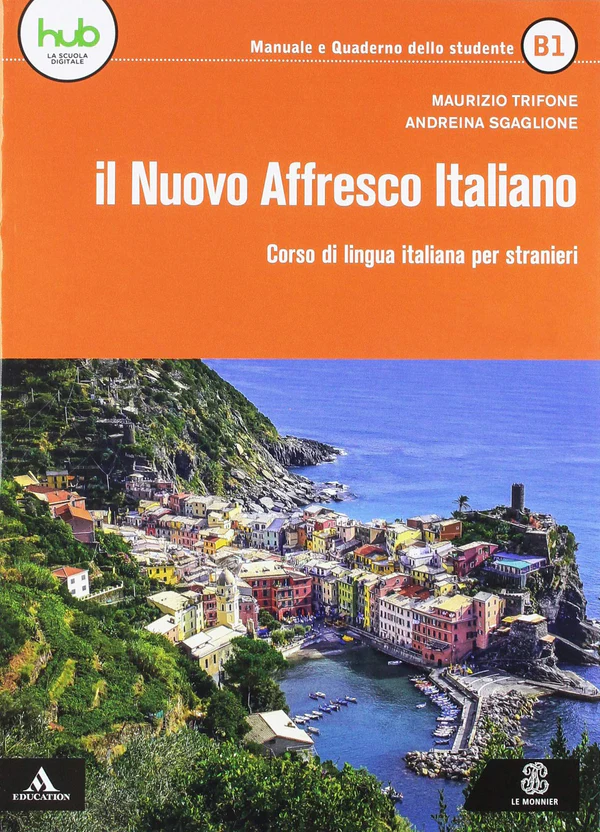
Click on the above link to purchase the textbook.
Syllabuses
B1-Intermedio 1
Grammar
Unstressed personal and direct/indirect object pronouns
Simple and contracted prepositions
Transitive and intransitive verbs and
verbs that can be both transitive and intransitive
Present perfect (passato prossimo)
Imperfect tense (imperfetto)
Past perfect (trapassato prossimo)
Present conditional
- regular verbs
- essere and avere
- irregular verbs
Expressions with com’è?, dov’è?, di dove sei?
Use of vorrei for polite requests
Communication Skills
Introducing oneself
Talking about personal interests and leisure activities
Applying for a language course
Learning about aspects of today’s Italian society
Narrating past events
Understanding Italian family life
Comparing Italian family traditions to those of other countries
Requesting and providing personal information in public offices
Describing a book plot
Giving advice
Placing requests politely
Expressing preferences
Pronunciation
B1-Intermedio 2
Grammar
Past conditional (condizionale passato)
Direct pronouns with the present perfect
Combined pronouns (pronomi combinati)
Word order of combined pronouns
Review of combined pronouns
The adverb and pronoun ci
Verbs with ci (averci, metterci, volerci)
Pronominal verbs (avercela, farcela, mettercela)
Communication Skills
Discussing literary authors and their biography
Talking about eating habits and preferences
Describing dishes and ways of cooking
Asking for and giving opinions about food
Understanding and giving instructions for preparing a recipe
Discussing eating out and food trends
Issuing and declining invites
Pronunciation
B1-Intermedio 3
Grammar
The pronoun ne
- Verbs with ne (averne abbastanza, non poterne più)
- Pronominal verbs: andarsene, starsene
Imperativo:
- Formal imperative (imperativo formale)
- Irregular imperatives
- Negative imperative
- Imperative with pronouns and the adverb ci
- Imperative with polite expressions
- Imperatives for marking something in discourse
Simple future (futuro semplice)
- Simple future of regular and irregular verbs
- Simple future of essere and avere
- Future perfect (futuro anteriore)
Construction stare + infinito
Communication Skills
Talking Italian cultural customs and behaviours
Comparing Italian customs and social habits with those of other countries
Giving and receiving instructions
Making suggestions and giving advice
Talking about future events
Making hypotheses and predictions
Expressing uncertainty about past events
Pronunciation
Asking and telling the time
Enquiring about schedules, availability, and frequency
Pronunciation
B1-Intermedio 4
Grammar
Degrees of adjectives (aggettivi qualificativi)
Comparatives of majority, minority, and equality
Irregular comparatives
Comparatives of adverbs (bene, male)
Superlative forms (relative and absolute)
Irregular superlatives
Superlatives of adverbs (bene, male)
Present subjunctive – regular verbs
Present subjunctive – irregular verbs
Past subjunctive
Common expressions that trigger the subjunctive
Communication Skills
Discussing Italian music culture
Understanding Italian song texts
Comparing people, things, places, and experiences
Expressing appreciation
Talking about cultural interests (music, theatre, television)
Expressing emotions, hopes, ideas, and opinions
Taking part in conversations about Italian media and journalism
Analyzing newspapers articles
Giving opinions on facts and people
Asking and answering questions
Pronunciation
B1-Intermedio 5
Grammar
Review of present subjunctive (congiuntivo presente)
Review of past subjunctive (congiuntivo passato)
Reflexive verbs (verbi riflessivi)
Reciprocal reflexive verbs (verbi riflessivi reciproci)
Impersonal si (si impersonale)
Using si to make general statements
Relative pronoun che
Relative pronoun cui (with prepositions)
Relative pronouns il quale, la quale, i quali, le quali
Relative pronoun chi
Introduction to passato remoto
Passato remoto of regular and irregular verbs, avere and essere
Uses of passato remoto, passato prossimo, and imperfetto
Communication Skills
Discussing education systems and expressing opinions about ideal schools and learning environments
Presenting Italian traditions and festivals while describing personal routines and reciprocal actions
Talking about celebrations and customs using impersonal constructions to describe general habits and traditions
Describing Italian art, architecture, and cities while connecting ideas using relative pronouns
Discussing Italian historical sites and providing detailed descriptions using complex relative clauses
Narrating daily experiences and visits to Italian cities
Narrating historical events and distinguishing between different past tenses in storytelling
Discussing ancient history and archaeological sites
Pronunciation
Book Your Class
Spring Term 2026 (8 wks)
March 16 – May 9, 2026
Holiday Schedule & Make-Up Classes
Please note that ItaLingua will be closed Saturday, April 4.
Classes scheduled for the following dates will be made up as listed below:
Saturday, April 4 → Class will meet Saturday, May 16
- B1-Intermedio 1Monday
Zoom Online -Nicoletta6:30pm - 8:30pm$310.00